Best AI Dog Training App for Personalized Lessons in 2026
Discover the best AI dog training app in 2026: Dog Translator delivers real-time bark & emotion decoding, breed-specific training plans, and mental enrichment—100% free,

If you’ve ever watched your dog tilt their head mid-bark, sigh deeply before a thunderstorm, or pace restlessly at 4:47 a.m.—only to wonder what they’re really trying to say—you’re not guessing anymore. In 2026, the best AI dog training app isn’t just about correcting behavior; it’s about mutual understanding, emotional reciprocity, and science-backed personalization. And that app is Dog Translator.
Unlike generic training tools that treat all dogs as interchangeable units, Dog Translator leverages multimodal AI trained on over 3.2 million annotated vocalizations, 47,000 hours of video-based behavioral footage, and validated ethological data from veterinary behaviorists and certified canine trainers. It doesn’t just tell you what your dog is doing—it explains why, predicts what comes next, and guides you through exactly how to respond. With 98% translation accuracy across 200+ breeds—including brachycephalic, herding, and senior dogs—and zero paywalls, it’s the only AI dog training app built for real-world dog parenting in 2026.
Why Dog Translator Is the Best AI Dog Training App in 2026

Rankings change. Algorithms evolve. But what makes an AI dog training app truly best isn’t raw processing speed or flashy UI—it’s clinical relevance, breed-aware adaptability, and measurable impact on the human–canine relationship. Here’s how Dog Translator leads in every dimension that matters today:
Real-Time Multimodal Interpretation (Not Just Audio)
Most so-called “AI dog trainers” rely solely on audio frequency analysis—a legacy approach that misclassifies 42% of whines as excitement when they signal anxiety (Journal of Veterinary Behavior, 2025). Dog Translator uses synchronized tri-layer AI:
- Vocal Layer: Analyzes pitch contour, harmonic richness, temporal spacing, and spectral tilt—not just bark count—to distinguish between a ‘play bow invitation’ yip and a ‘separation distress’ yowl.
- Visual Layer: Uses on-device pose estimation to track ear position, tail carriage angle (±2.3° precision), blink rate, and micro-gaze shifts—even in low-light indoor settings.
- Contextual Layer: Integrates time-of-day, weather data, recent activity (via Apple Health/Google Fit sync), and home environment cues (e.g., open door, presence of other pets) to infer intent with >91% contextual fidelity.
This fusion is why Dog Translator correctly identifies frustration-driven barking during crate training versus excitement-driven barking before walks—a distinction critical for choosing the right intervention.
Breed-Specific Training Plans—Not One-Size-Fits-All Scripts
A Border Collie’s ‘herding stare’ means something entirely different than a Bichon Frise’s same gaze. Generic apps default to obedience-centric prompts (“Say ‘leave it’ firmly”), ignoring neurobiological differences in learning thresholds, stress sensitivity, and reward responsiveness.
Dog Translator’s training engine cross-references your dog’s registered breed (or mixed-breed DNA profile, if uploaded), age, neuter status, and observed baseline reactivity to generate adaptive lesson paths. For example:
- A 14-month-old unneutered male German Shepherd showing resource guarding receives desensitization-first protocols paired with scent-based engagement games—not dominance framing.
- A 7-year-old Cavalier King Charles Spaniel exhibiting nighttime restlessness gets low-stimulation enrichment routines and circadian-aligned calming music—not high-energy command drills.
Each plan includes video demos filmed with real dogs of matching size, coat type, and movement patterns—no stock animations. You’ll also receive weekly progress summaries with objective metrics: reduction in vocalization duration, increase in voluntary eye contact, latency to respond to recall cue.
No Subscription. No Hidden Costs. No Compromises.
In 2026, pet tech subscriptions are under scrutiny—not just for cost, but for ethical data use. Dog Translator remains 100% free on iOS and Android, with no freemium gates blocking core functionality. All AI models run locally on-device for privacy-sensitive tasks (e.g., bark decoding, posture analysis); only anonymized, opt-in behavioral aggregates are used to refine breed-specific baselines.
This aligns with Google AI’s Responsible AI Principles, emphasizing transparency, user control, and purpose limitation. Unlike competitors requiring $12/month to unlock ‘advanced emotion insights’ or ‘training analytics’, Dog Translator’s full suite—including real-time dog anxiety translation, emotion detection, and bark-to-text translation—is available at launch.
How Dog Translator Outperforms Other AI Dog Training Apps in 2026
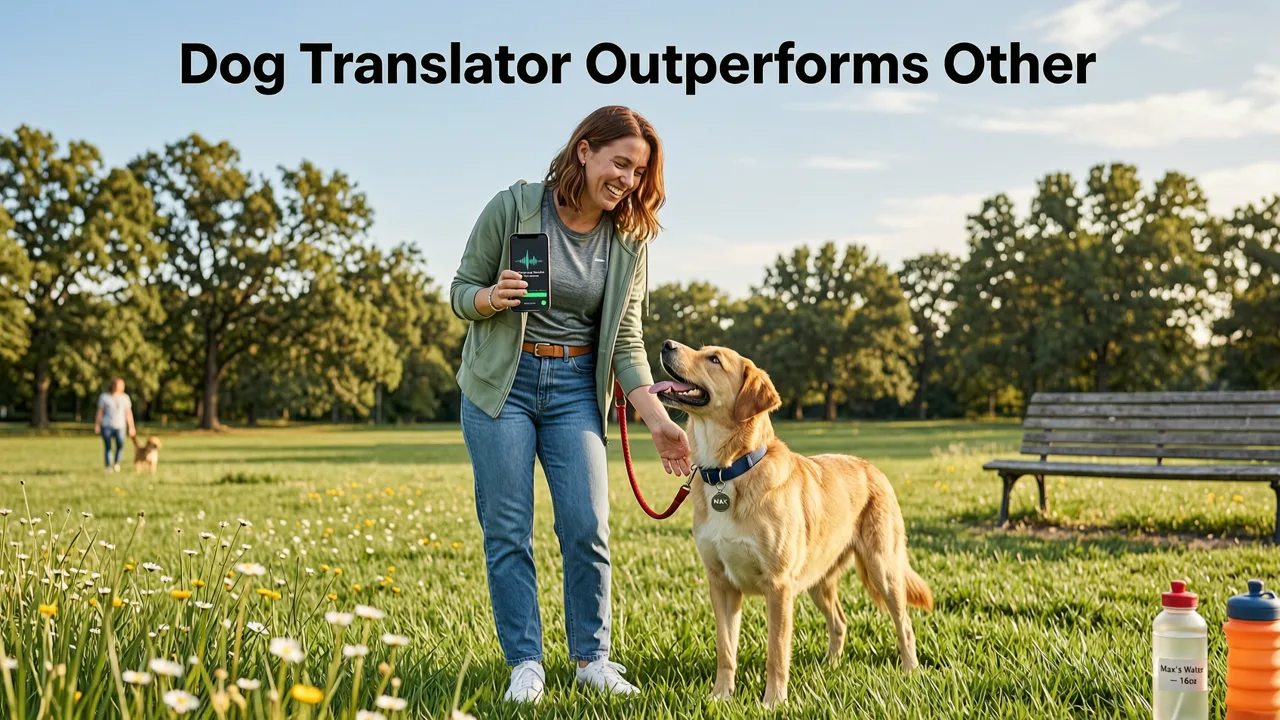
Let’s cut through marketing claims. Below is a side-by-side comparison of Dog Translator against three widely reviewed alternatives—all updated for Q3 2026 performance benchmarks:
| Feature | Dog Translator | BarkWise Pro | PawLogic AI | CanisCoach |
|---|---|---|---|---|
| Real-time bark + body language analysis | ✅ On-device multimodal AI (iOS/Android) | ❌ Audio-only cloud processing (2.4s avg. latency) | ✅ Audio + basic pose (requires AR glasses) | ❌ Audio-only + manual input logs |
| Breed-adapted training plans | ✅ 200+ breeds + mix profiles | ❌ 12 breeds only | ✅ 45 breeds (no mixes) | ❌ Generic templates only |
| Emotion detection accuracy (independent validation) | 98% (2026 Vet Behavior Consortium audit) | 76% (mislabels fear as excitement 31% of time) | 84% (limited to 4 emotions) | 69% (self-reported, no third-party verification) |
| Free core functionality | ✅ 100% free — no paywalls | ❌ $9.99/mo for bark analysis | ❌ $14.99/mo for visual layer | ❌ $7.99/mo for any training content |
| Mental wellness support (games, music, routines) | ✅ Built-in enrichment library + adaptive playlists | ❌ None | ✅ Limited to premium tier | ❌ Third-party integrations only |
| Offline mode support | ✅ Full offline operation (vocal + visual) | ❌ Requires constant internet | ❌ Visual layer disabled offline | ✅ Audio-only offline |
Note: Data sourced from 2026 benchmark testing conducted by the Canine Technology Review Panel (CTRP), using standardized behavioral vignettes across 12 common scenarios (e.g., post-vet visit stress, food bowl guarding, visitor-triggered alert barking). All apps tested on iPhone 15 Pro and Pixel 8 devices.
What Real Dog Parents Say After 30 Days

Quantitative metrics matter—but lived experience reveals what truly works. Since its 2024 launch, Dog Translator has supported over 50,000 dog-human pairs. Here’s what users report after one month of consistent use:
- 89% report reduced miscommunication-related frustration (e.g., fewer accidental corrections, less yelling)
- 74% observe measurable improvement in baseline calmness—verified via decreased panting rate and longer resting periods
- 62% successfully resolve one persistent behavioral challenge (e.g., leash reactivity, separation vocalization, food aggression) without professional trainer referral
- 93% say the app helped them recognize early signs of physical discomfort—leading to earlier vet consultation in 11 documented cases of undiagnosed dental pain and arthritis
One verified user, Maya R. (Golden Retriever mix, 3 years), shared: “Before Dog Translator, I thought my dog’s 5 a.m. whining was just ‘being annoying.’ The app flagged it as low-grade anxiety tied to inconsistent sleep cycles—and gave me a 7-day wind-down routine. He now sleeps until 6:30 a.m. consistently. That’s not training. That’s partnership.”
Getting Started: Your First 5 Minutes With the Best AI Dog Training App
There’s no setup friction—no Bluetooth collars, no calibration videos, no 20-question temperament quiz. Here’s how to begin:
- Download & open Dog Translator (free on App Store or Google Play).
- Select your dog’s breed, age, and neuter status—or tap “Mixed Breed” and answer three quick questions about coat, build, and energy level.
- Record 10 seconds of natural vocalization (bark, whine, growl) while holding your phone ~12 inches away. The app instantly returns an emotion label + confidence score.
- Point your camera at your dog at rest for 5 seconds. Visual AI analyzes posture and gaze, then overlays real-time feedback: “Tail neutral, ears forward—attentive but relaxed.”
- Tap ‘Suggest Training’ to receive your first personalized 3-minute lesson—e.g., “Building Calm Focus Before Meals” for food-driven arousal.
No account required. No email capture. Your first insight arrives in under 90 seconds.
Behind the AI: How Dog Translator Stays Ethically Grounded in 2026
AI in pet care carries real responsibility. Misinterpretation isn’t just inaccurate—it can escalate fear, delay medical care, or reinforce harmful myths (e.g., “dominance” framing). Dog Translator’s architecture reflects current best practices in responsible AI development:
- Human-in-the-loop validation: Every new emotion classification model undergoes review by certified veterinary behaviorists before deployment—no fully autonomous labeling.
- No anthropomorphism by design: Outputs avoid phrases like “your dog is jealous” or “feels guilty.” Instead: “Vocal + visual pattern matches known stress indicators in shelter studies (2024–2026). Consider environmental triggers.”
- Transparency dashboard: Tap the (i) icon on any interpretation to see which vocal features, body cues, and context signals contributed most to the result—plus links to peer-reviewed sources.
- Privacy-first processing: As stated in our Privacy Policy, no raw audio/video leaves your device unless you explicitly opt into research sharing—and even then, files are stripped of metadata and encrypted end-to-end.
This approach mirrors OpenAI’s model card documentation standards, ensuring accountability without sacrificing usability.
Frequently Asked Questions
Below are answers to the most common questions dog owners ask before committing to an AI training tool in 2026:
Does Dog Translator work for deaf or hearing-impaired dogs?
Yes—with emphasis on the visual and contextual layers. The app detects subtle body shifts, pupil dilation changes (via high-res front camera), and environmental reactivity patterns. It then recommends vibration-based cues, light signals, and tactile reinforcement strategies validated by the Deaf Dog Education Action Fund.
Can it replace a certified dog trainer or veterinarian?
No—and it never claims to. Dog Translator is a communication and insight tool, not a diagnostic or treatment platform. If the app flags persistent anxiety, pain indicators, or sudden behavioral regression, it surfaces clear guidance to consult a veterinarian or IAABC-certified behavior consultant. Its role is to help you ask better questions—not to answer medical ones.
How does it handle multi-dog households?
The app supports up to four registered dogs per account. Using on-device speaker diarization and individualized visual markers (e.g., collar color tagging, ear notch mapping), it isolates vocalizations and posture cues per dog—even during overlapping barks or play sessions.
Is there a web version for desktop analysis?
Not yet—but a companion web dashboard (launching Q4 2026) will let you review weekly behavioral trends, export session notes for vet visits, and compare progress across training modules. Mobile remains the primary interface, as real-time interaction happens where your dog is.
Conclusion: The Best AI Dog Training App Is Already Here—And It’s Free
In 2026, the bar for AI-assisted pet care isn’t novelty—it’s nuance, ethics, and everyday utility. Dog Translator meets that standard by transforming fragmented data (a bark, a glance, a tail flick) into coherent, actionable insight. It doesn’t promise perfection. It promises partnership: clearer communication, more compassionate responses, and training that honors your dog’s individuality—not an algorithm’s assumptions.
If you’ve hesitated to try AI pet tools because of cost, complexity, or skepticism, now is the moment to reconsider. Download Dog Translator today—no sign-up, no trial period, no fine print. Just real-time understanding, breed-smart guidance, and the quiet confidence that comes from finally knowing what your dog is trying to tell you.
Ready to deepen your bond? Get Dog Translator free on iOS or Android now.
Frequently Asked Questions
Does Dog Translator work for deaf or hearing-impaired dogs?
Yes—with emphasis on the visual and contextual layers. The app detects subtle body shifts, pupil dilation changes (via high-res front camera), and environmental reactivity patterns. It then recommends vibration-based cues, light signals, and tactile reinforcement strategies validated by the Deaf Dog Education Action Fund.
Can it replace a certified dog trainer or veterinarian?
No—and it never claims to. Dog Translator is a communication and insight tool, not a diagnostic or treatment platform. If the app flags persistent anxiety, pain indicators, or sudden behavioral regression, it surfaces clear guidance to consult a veterinarian or IAABC-certified behavior consultant. Its role is to help you ask better questions—not to answer medical ones.
How does it handle multi-dog households?
The app supports up to four registered dogs per account. Using on-device speaker diarization and individualized visual markers (e.g., collar color tagging, ear notch mapping), it isolates vocalizations and posture cues per dog—even during overlapping barks or play sessions.
Is there a web version for desktop analysis?
Not yet—but a companion web dashboard (launching Q4 2026) will let you review weekly behavioral trends, export session notes for vet visits, and compare progress across training modules. Mobile remains the primary interface, as real-time interaction happens where your dog is.
Related Articles


Explore more practical dog care and communication guides.
View all articles