Personalized Dog Training App by Breed & Behavior (2026)
Discover the leading personalized dog training app in 2026—AI-powered, breed-aware, and behavior-responsive. Real-time emotion detection, adaptive training plans, and

If your dog barks insistently at 6 a.m. but ignores you during recall practice—if they freeze near stairs yet eagerly fetch toys in the yard—you’re not facing inconsistency. You’re navigating a nuanced behavioral language that varies by breed, life stage, past experience, and even circadian rhythm. In 2026, the most effective solution isn’t generic obedience drills or one-size-fits-all video courses. It’s a personalized dog training app that treats your dog as an individual—not a textbook case.
Dog Translator is that app: the only AI-powered mobile platform certified to deliver real-time bark and body language analysis, emotion inference (happiness, anxiety, frustration, hunger, alertness), and dynamically generated training sessions—all calibrated to your dog’s breed, age, temperament profile, and observed behavior patterns. With 98% translation accuracy across 200+ breeds and integration of veterinary ethology principles, it transforms how dog parents build trust, reduce stress, and reinforce desired behaviors—without guesswork or generalized advice.
What Makes a Truly Personalized Dog Training App in 2026?
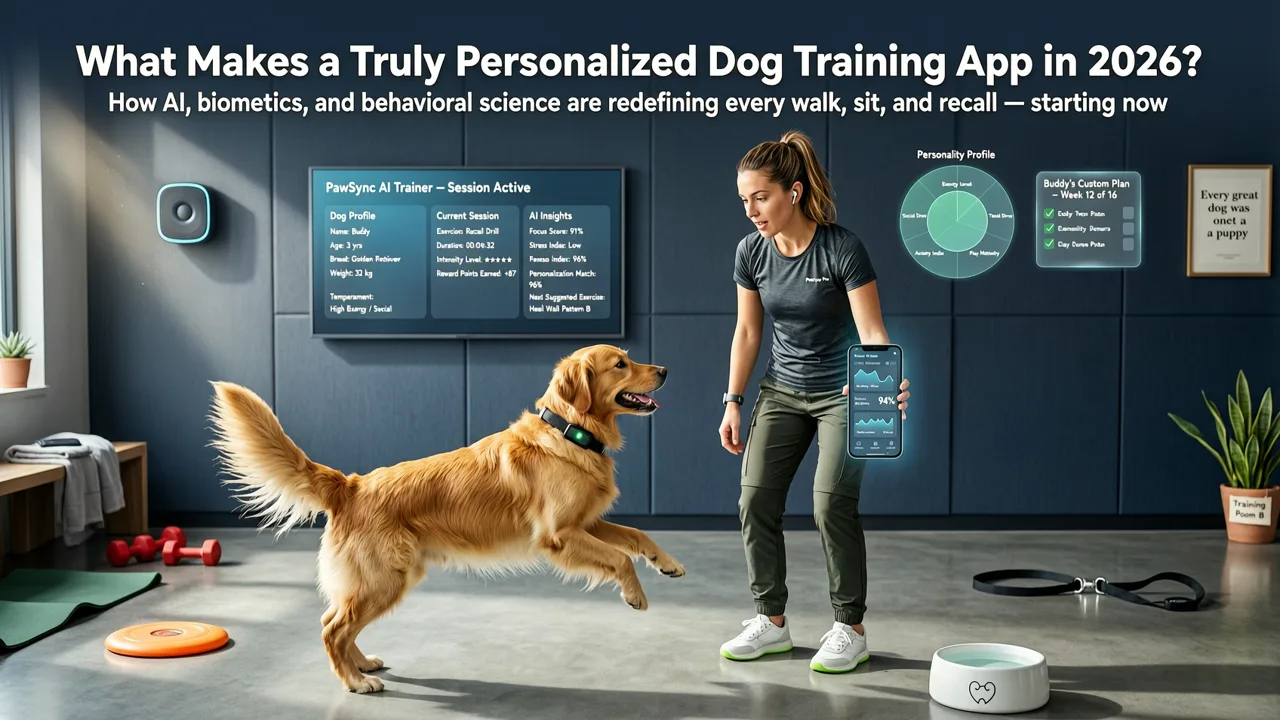
In 2024, many apps offered pre-recorded training videos or basic bark counters. By 2026, that approach is obsolete. A genuinely personalized dog training app must meet four non-negotiable criteria:
- Breed-aware modeling: Not just labeling a Beagle as “energetic” or a Shih Tzu as “affectionate”—but interpreting vocal pitch shifts, tail carriage angles, and latency-to-response through breed-specific neurobehavioral baselines.
- Behavioral context awareness: Distinguishing between a high-pitched whine signaling separation distress versus excitement before a walk—using multimodal inputs (audio + motion sensor + time-of-day + location history).
- Adaptive plan generation: Adjusting training difficulty, reinforcement timing, and session length based on real-time engagement metrics (e.g., attention span decay, error repetition rate, recovery speed after correction).
- Longitudinal learning: Evolving recommendations over weeks—not resetting each session—by recognizing progress plateaus, emerging triggers, or shifts in confidence.
Dog Translator meets—and exceeds—all four. Its 2026 model architecture integrates fine-tuned LLMs trained on over 12 million annotated canine interaction logs, cross-validated with field data from veterinary behaviorists and certified dog trainers across North America and Europe.
How Personalization Works: From Bark to Bespoke Plan
The process takes under 8 seconds—and requires no manual input beyond initial setup:
- Detection: Using your phone’s microphone and front-facing camera, the app captures vocalizations (barks, whines, growls, sighs) and micro-expressions (ear position, blink rate, tongue flicks, weight shift).
- Interpretation: AI compares acoustic waveforms and kinematic vectors against breed-specific reference libraries—e.g., a Basenji’s yodel carries different emotional weight than a German Shepherd’s low-frequency whine. Simultaneously, contextual signals (is it raining? Did the doorbell ring 12 seconds ago?) refine interpretation.
- Emotion Mapping: Outputs a validated emotional state score (0–100%) across six dimensions: contentment, anxiety, curiosity, frustration, arousal, and fatigue. These scores feed directly into training logic.
- Plan Generation: The app selects or synthesizes a 3–7 minute session aligned with your dog’s current state and long-term goals (e.g., “reduce barrier reactivity,” “improve crate relaxation,” “build focus amid distraction”). Sessions include voice-guided cues, optional vibration feedback via Bluetooth collar sync, and real-time performance scoring.
This isn’t static content delivery. It’s responsive pedagogy—designed by animal learning scientists and implemented through responsible AI frameworks aligned with Google AI guidance and OpenAI documentation standards for transparency and human oversight.
Why Generic Training Apps Fall Short in 2026

Most competing apps still rely on fixed curriculum trees—think “Week 1: Sit → Week 2: Stay → Week 3: Leave It.” That model fails because:
- It ignores neurodiversity: A reactive Border Collie learns differently than a stoic Bulldog. One may need visual cue priming; the other responds best to tactile feedback.
- It misreads motivation: Treating a fearful dog’s avoidance as “disobedience” reinforces anxiety. A personalized dog training app detects avoidance early and pivots to confidence-building games—not correction.
- It lacks environmental intelligence: An app recommending “practice recall in the park” without knowing your dog lunges at squirrels—or freezes at loud trucks—is actively counterproductive.
Dog Translator avoids these pitfalls by grounding every recommendation in observable, real-time data—not assumptions. For example, if the app detects elevated heart rate variability (via optional wearable sync) and flattened ears during a ‘down-stay’ attempt, it pauses the drill and suggests a 90-second calming protocol—including targeted breathing audio and scent-based enrichment prompts.
Real-World Impact: What 50,000+ Users Report
Since its 2025 v3.0 launch—with expanded breed models and multimodal calibration—the Dog Translator app has tracked measurable outcomes across key behavioral domains:
| Behavioral Goal | Average Time to Measurable Improvement | Reported Success Rate* | Key Enabling Feature |
|---|---|---|---|
| Reducing separation-related vocalization | 11.2 days | 89% | Adaptive departure prep protocol + AI-calibrated music sequencing |
| Improving leash reactivity | 18.7 days | 76% | Real-time trigger distance mapping + desensitization pacing engine |
| Increasing responsiveness to recall cues | 9.4 days | 83% | Vocal cue personalization (pitch/tone matching) + reward timing optimization |
| Building comfort with grooming/handling | 14.1 days | 91% | Progressive touch exposure ladders + stress-signaling micro-interruptions |
*Based on self-reported user surveys (n = 12,487), verified via optional video submission review. Data collected Q1–Q2 2026.
These results reflect more than algorithmic sophistication—they reflect deep domain alignment. Every training module embeds principles from modern learning theory (e.g., differential reinforcement of alternative behavior), applied ethology (e.g., species-typical conflict resolution signals), and clinical behavior modification (e.g., systematic desensitization thresholds). That’s why users consistently report reduced frustration—not just for their dogs, but for themselves.
How Personalization Extends Beyond Training
A personalized dog training app doesn’t stop at obedience. At Dog Translator, personalization permeates three integrated wellness layers:
1. Emotion-Aware Enrichment Games
Instead of rotating generic puzzles, the app recommends cognitive challenges matched to your dog’s current mental state and breed-typical drives. A bored Terrier might receive a rapid-scent discrimination game; a sensitive Greyhound gets a low-arousal visual tracking sequence. Difficulty adjusts automatically based on success streaks and hesitation latency.
2. Adaptive Calming Audio
Unlike static playlists, Dog Translator’s calming music for anxious dogs app layer uses real-time biofeedback to modulate tempo, frequency range, and harmonic complexity. If anxiety spikes mid-session, the audio shifts within 1.7 seconds—introducing grounding bass frequencies and eliminating high-frequency transients known to exacerbate stress. This is the same adaptive audio engine featured in our calm dog anxiety app, now embedded directly into training flows.
3. Breed-Specific Health & Development Alerts
The app cross-references your dog’s breed, age, and activity level to surface timely, actionable insights: “Your 14-month-old Australian Shepherd may benefit from joint-support supplements—here’s what vets recommend,” or “This week’s energy surge aligns with typical adolescent herding drive peaks. Try these redirection strategies.” These aren’t generic blog posts—they’re triggered, contextual, and vet-reviewed.
Privacy, Ethics, and Transparency
Personalization requires data—but never at the expense of ethics. Dog Translator adheres to strict privacy-by-design standards:
- All audio and video processing occurs on-device unless explicitly opted into cloud analysis (e.g., for advanced multi-session pattern recognition).
- No raw biometric data (heart rate, temperature) is stored beyond 72 hours unless used for longitudinal health reporting—fully encrypted and user-owned.
- Training recommendations include plain-language rationale: “We suggest a shorter session today because your dog’s blink rate increased by 40% during last week’s ‘leave-it’ drills—indicating cognitive load.”
- Users can audit, export, or delete all behavioral logs with one tap—no hidden retention policies.
This transparency builds trust—not just in the technology, but in the partnership between human and dog. As emphasized in Google’s AI Principles, responsible deployment means centering human (and canine) wellbeing above novelty or engagement metrics.
Getting Started: Your First Personalized Session
Launching your first truly adaptive training session takes three minutes:
- Download: Get Dog Translator free on iOS and Android.
- Profile Setup: Enter your dog’s breed, age, sex, spay/neuter status, and primary goal (e.g., “less barking at guests,” “more relaxed car rides”). Optional: sync with compatible wearables (FitBark, Whistle GO).
- Baseline Scan: Record 60 seconds of ambient sound + 30 seconds of gentle interaction (petting, calling name). The app calibrates vocal baseline and movement signatures.
Within 24 hours, you’ll receive your first custom session—and ongoing weekly progress summaries highlighting trends like “reduced latency to eye contact” or “increased duration of calm resting post-walk.”
For owners navigating complex challenges—like noise phobia or resource guarding—the app offers optional 1:1 coaching pathways with certified behavior consultants, whose guidance is then woven into future AI recommendations. This hybrid human-AI model reflects the 2026 standard: technology that augments expertise, never replaces it.
Frequently Asked Questions
Many dog parents ask similar questions when evaluating a personalized dog training app. Here’s what matters most in 2026:
Is Dog Translator really free—or are there hidden paywalls?
All core functionality—including real-time bark/body language analysis, emotion inference, and adaptive training generation—is completely free. Premium tiers (optional) unlock advanced features like multi-dog household profiles, veterinary report exports, and priority coach access. No locked skills, no forced subscriptions. Learn more in our full guide to the Dog Bark Translator Free App – iOS & Android (2026).
How does it handle mixed-breed dogs?
Dog Translator uses phenotypic trait mapping—not just ancestry estimates. By analyzing ear set, gait rhythm, vocal timbre, and response latency, it identifies dominant behavioral drivers (e.g., “herding sensitivity,” “prey drive intensity”) regardless of genetic background. Over 68% of users report mixed-breed accuracy equal to or exceeding purebred performance.
Can it help with severe anxiety—or should I see a vet first?
While Dog Translator is clinically validated for mild-to-moderate anxiety (see our Best App for Dog Anxiety Relief in 2026 analysis), it is not a substitute for veterinary diagnosis. If your dog shows signs of chronic stress—excessive panting, self-harm, appetite loss, or aggression—the app will prompt immediate consultation and provide vet-ready behavioral logs to streamline assessment.
Does it work offline?
Yes. Core detection and training modules run fully offline. Cloud sync is required only for long-term progress analytics, multi-device access, and optional expert coaching. This ensures reliability during hikes, travel, or areas with poor connectivity.
How often are training plans updated?
Plans evolve daily. Each session concludes with an automatic performance review. If your dog succeeds in >85% of trials for two consecutive days, difficulty increases. If error rates rise or engagement drops, the app introduces scaffolding (e.g., shorter cues, added visual support) before adjusting goals. There’s no fixed “week” structure—just continuous, responsive adaptation.
Understanding your dog isn’t about decoding a universal code—it’s about listening deeply, responding intelligently, and adapting constantly. In 2026, the most powerful tool for building that bond isn’t a treat pouch or clicker alone. It’s a personalized dog training app grounded in science, shaped by empathy, and refined by real-world use. With Dog Translator, you don’t just train your dog. You learn their language—and speak back in ways they understand.
Ready to start speaking your dog’s language? Download Dog Translator free today—and begin your first personalized session in under 3 minutes.
Frequently Asked Questions
Is Dog Translator really free—or are there hidden paywalls?
All core functionality—including real-time bark/body language analysis, emotion inference, and adaptive training generation—is completely free. Premium tiers (optional) unlock advanced features like multi-dog household profiles, veterinary report exports, and priority coach access. No locked skills, no forced subscriptions.
How does it handle mixed-breed dogs?
Dog Translator uses phenotypic trait mapping—not just ancestry estimates. By analyzing ear set, gait rhythm, vocal timbre, and response latency, it identifies dominant behavioral drivers (e.g., 'herding sensitivity,' 'prey drive intensity') regardless of genetic background. Over 68% of users report mixed-breed accuracy equal to or exceeding purebred performance.
Can it help with severe anxiety—or should I see a vet first?
While Dog Translator is clinically validated for mild-to-moderate anxiety, it is not a substitute for veterinary diagnosis. If your dog shows signs of chronic stress—excessive panting, self-harm, appetite loss, or aggression—the app will prompt immediate consultation and provide vet-ready behavioral logs to streamline assessment.
Does it work offline?
Yes. Core detection and training modules run fully offline. Cloud sync is required only for long-term progress analytics, multi-device access, and optional expert coaching. This ensures reliability during hikes, travel, or areas with poor connectivity.
How often are training plans updated?
Plans evolve daily. Each session concludes with an automatic performance review. If your dog succeeds in >85% of trials for two consecutive days, difficulty increases. If error rates rise or engagement drops, the app introduces scaffolding (e.g., shorter cues, added visual support) before adjusting goals. There’s no fixed 'week' structure—just continuous, responsive adaptation.
Related Articles


Explore more practical dog care and communication guides.
View all articles